Blog 5: Final Weeks
- Andrea Sarmiento
- Oct 20, 2024
- 6 min read

Context | We are entering the final stretch of our capstone project, with just a few weeks remaining. These upcoming weeks will be crucial as they involve a flurry of activity, including the finalisation of prototypes and other key deliverables.
Our focus will shift to refining the details, ensuring every element aligns with the overall vision of the project. This phase requires close attention to feedback, making adjustments as needed, and polishing all aspects of our work. It’s not just about completing the tasks but delivering a high-quality product that reflects the effort and creativity we've invested over the course of the project.
As deadlines approach, effective time management and collaboration will be more important than ever to ensure we meet all requirements and prepare for our final presentation.
Action | This week, I created an area allocation diagram to illustrate how I’ve divided the spaces in my design. The areas I incorporated were based on survey results that highlighted the features Auckland CBD workers would like to see in the park.

This week, I consulted with a few people to get their preferences on the two layout options I created. We all agreed that Layout B was more favourable, as its design is symmetrical on both sides and offers additional features compared to Layout A. Layout B includes more seating areas and introduces a stage that can be used for events or performances, which adds versatility to the space.
The finalised spaces are – a shaded seating area, stage/performance area, community garden, art display area, water feature, and collaborative area (tables and chairs).
This week, I began 3D modelling my design using SketchUp. While working on the model, I realized that my initial area allocation was significantly off. One of the walking trails I designed, which runs through the centre of space, intersects with a skylight from the train station below. This unexpected issue has prompted me to reassess the layout and make adjustments to ensure that the design functions harmoniously with the existing infrastructure.
One of the most significant changes I made was to the shaded area. I experimented with different roofing styles but ultimately settled on a woven pattern roof, which complements the overall aesthetic of the design.


As I continued modelling in SketchUp, I made adjustments along the way. To keep track of these changes, I took screenshots throughout the process. There were moments when I designed directly in 3D without sketching first, given time constraints. For example, the stage was designed on the spot to ensure I made fast, efficient decisions. I also modified the stage to have dual functionality: it can serve as additional seating, with movable pieces that can be rearranged or separated when the stage is not in use.

For rendering, I used an application called Enscape, with the goal of capturing most areas of the design in detail. I created two sets of renders—one for daytime and one for nighttime. The purpose of the nighttime render was to address a key concern: user safety after dark and how to deter homeless individuals from sleeping in the park.
To tackle this issue, I incorporated extensive lighting throughout the space, enhancing visibility and security at night. These renders will also be included in my project walkthroughs, making it easier for viewers to visualize the design during different times of the day. This will be an important part of my final deliverables.

Results | One of the most significant decisions I made was opting to use an application I was already familiar with: SketchUp. During my Years 11-13, I used SketchUp extensively for spatial design projects, so I found it much easier to navigate and work efficiently. Had I stuck with my original plan of using a different application, it would likely have taken me months to produce what I have now, as I would have faced a steep learning curve.
Although I did not know everything right away, I made good use of online resources, especially YouTube tutorials from channels like SketchUpEssentials, which helped me fill in the gaps. I also sought assistance from friends who study architecture. Their feedback and guidance were incredibly valuable, not only because they showed me how to solve specific problems but also because they taught me the skills and techniques to handle similar challenges in the future.
Had I chosen a new software, the results could have been quite different. I would have spent a considerable amount of time learning the interface, slowing down the progress of my project. There is also the possibility that I would not have had the same level of support, as my peers and online resources might not have been as readily available for unfamiliar applications.
In retrospect, choosing SketchUp allowed me to stay focused on the creative aspects of my project rather than being bogged down by technical hurdles. The time saved by using a familiar tool enabled me to spend more time refining my design, seeking feedback, and iterating on ideas. This decision also contributed to my ability to adapt quickly, make changes on the go, and produce a high-quality output within a tight timeframe.
Learnings | An important lesson I learned is that if you do not ask, the answer is automatically no. I often hesitate to seek help because I fear being an inconvenience. When I asked my friend for assistance, I was incredibly nervous, worried they might say no. However, to my surprise, they were more than willing to help. This experience taught me that people are often more generous with their time and knowledge than I initially assumed.
This lesson has helped me see that asking for help is not a sign of weakness but a necessary part of growth and learning. I realized that reaching out to others can actually lead to valuable exchanges, and it is a way of building stronger connections. The fear of being a burden should not hold me back because, more often than not, people are happy to share what they know.
I also learned that when you know something, even if you have not done it for a long time, it is easier to pick it back up than expected. For example, I had not used SketchUp in years, and I was worried that I might struggle with the interface. However, to my surprise, it did not take me long to get back into the flow of things. It was like riding a bike—once you learn it, you never really forget. A bit of practice was all I needed to refresh my memory, and soon enough, I was navigating the software with confidence.
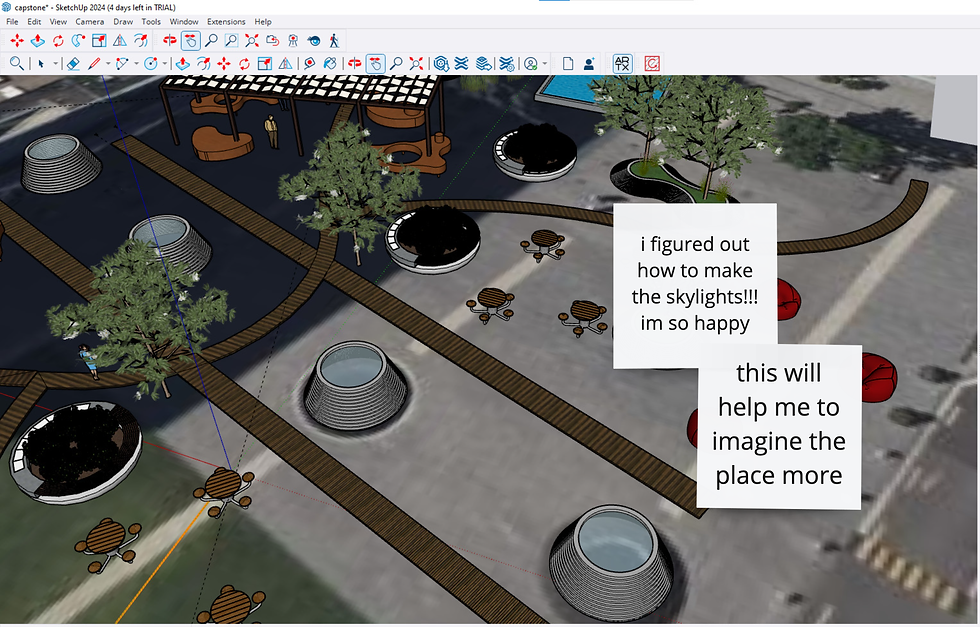
This experience reinforced the idea that the skills we acquire stay with us, even if they go unused for a while. It gave me the confidence to trust in my ability to adapt and re-engage with things I have learned in the past. The knowledge does not disappear; it just needs a little jump-start sometimes. By pushing through the initial hesitation, I was able to rediscover what I already knew and build on it, which was a rewarding experience.
Action Plan | To successfully finalise my deliverables, I need to focus on several key areas. First, I will review the current layout, which is Layout B, and make any final adjustments based on feedback or my own insights. It is important to double-check the symmetry on both sides to ensure that all features, such as seating spaces, walking trails, and the stage, are properly aligned. I will also confirm that the roofing and shaded areas are integrated harmoniously with the rest of the design, and I need to verify that the walking trail does not intersect with the skylights of the train station.
Next, I will finalize my 3D models to ensure they accurately represent the design and meet the project requirements. This will involve reviewing each element for accuracy and aesthetics. Additionally, I will determine if I need to create more renders, particularly focusing on different times of day to showcase how the park looks at night, emphasizing the lighting features that enhance safety. I want to ensure that my renders provide a comprehensive view of the space, highlighting all the key aspects of the design.
Finally, I will compile all of these elements into a cohesive presentation that includes both 3D models and videos. This presentation will not only showcase my design but also serve as a walkthrough for viewers to understand the park's layout and features effectively. By following this action plan, I aim to create a polished final deliverable that reflects my hard work and learning throughout the project


Comments